
Beijing Blindsided
China built its global strategy on the belief that America was fading. Seventy-two hours over Tehran shattered that illusion.

NOTE: Please consider upgrading your subscription here for $9 a month to help me keep this publication up and running. By standing with us, you lock arms with a community that refuses to give up on America, her healing, her future and her freedom. It’s a stand for what matters most. While everything here is free at the moment, your monthly financial subscription of $9 per month or $99 per year will help ensure that I can keep providing you and others with groundbreaking independent journalism and original political commentary. Your subscription for a nominal fee supports my journalistic efforts, and the expenses associated with my investigations. If you don’t want to miss any of my hard-hitting reports and commentary, please subscribe today!
Beijing, for once, did not see it coming.
The leadership compound in Zhongnanhai is famous for its discipline. Chinese leaders pride themselves on patience, on thinking decades ahead, on quietly building power while their rivals grow distracted or complacent.
Their diplomats talk constantly about “long-term historical trends.” Their strategists study the slow shifts of power across centuries.
Yet Operation Epic Fury has caught them flat-footed.
The confusion coming out of Beijing has been remarkable.
For years Chinese leadership projected an image of total strategic composure. The story they told their own population, and increasingly the world, was simple: America was declining, China was rising, and the global balance of power was inevitably shifting eastward.
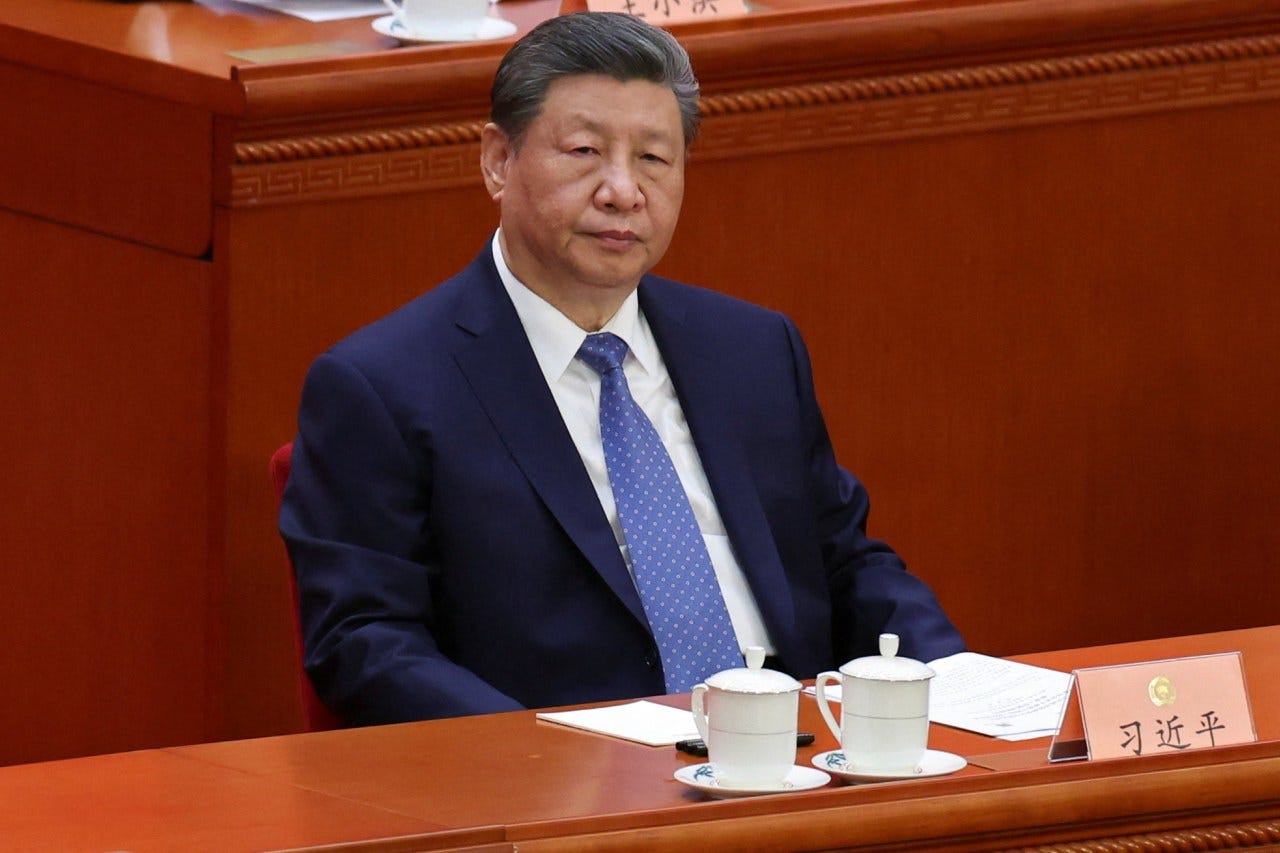
Xi Jinping himself said it plainly in 2021 when he told senior Communist Party officials that “the East is rising and the West is declining.”
That narrative has been the backbone of Chinese foreign policy for the past decade. In 72 hours, it collapsed.
And suddenly their narrative looks a lot less convincing.
Operation Epic Fury did not simply strike Iranian targets. It shattered one of the quiet pillars supporting Beijing’s global strategy.
For China, Iran was never just another partner. It was a geopolitical counterweight.
Iran served a specific strategic purpose in the Chinese worldview. It kept American attention tied down in the Persian Gulf. It offered Beijing a sanctions-resistant oil supplier. And perhaps most importantly, it functioned as living proof that American power had limits.
For more than forty years, Washington sanctioned Tehran, threatened Tehran, isolated Tehran, and yet the Islamic Republic remained standing.
To Beijing’s strategists, that endurance was useful.
It allowed them to tell themselves that American pressure campaigns could be resisted indefinitely. It reinforced the idea that the United States had entered a phase of slow decline where decisive force was politically impossible.
Then seventy-two hours over Tehran changed the calculus.
Keep reading with a 7-day free trial
Subscribe to The Tony Seruga Dispatch to keep reading this post and get 7 days of free access to the full post archives.